

Mercer Mass Timber Sees Strong Korean Market Potential at JJAF 2025 International Seminar

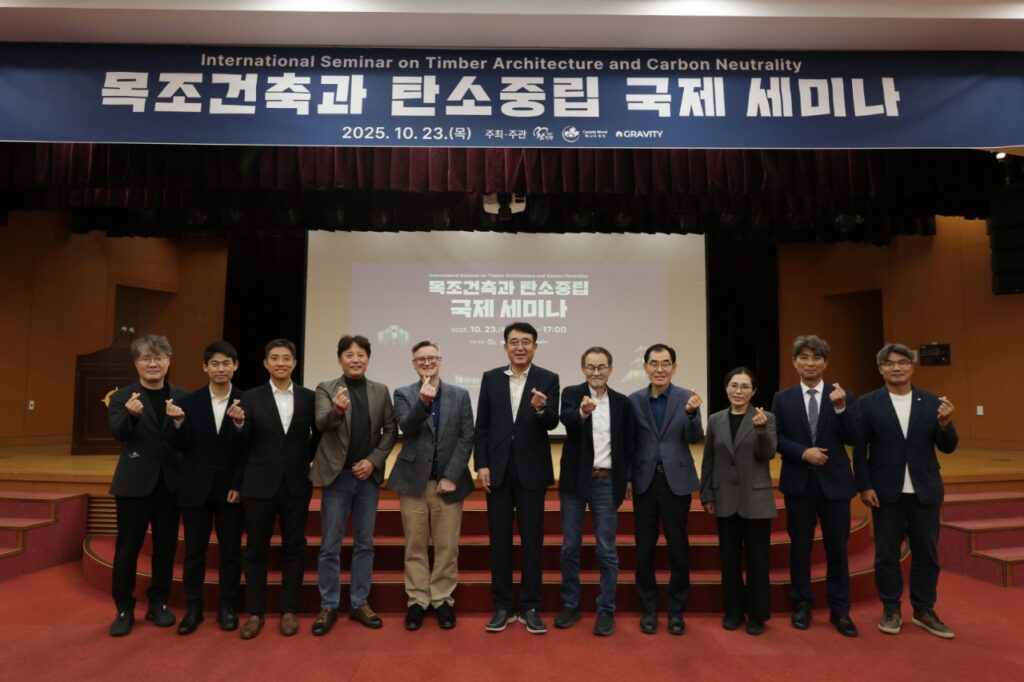
At the Jinju Jeongchuk Architecture Festival (JJAF 2025), the International Seminar on Wood Construction and Carbon Neutrality drew strong interest, featuring a presentation by Mercer Mass Timber, one of Canada’s leading mass timber companies.
Co-hosted by Canada Wood Korea, Jinju City, and Gravity Inc., the seminar attracted more than 200 participants, including architects, engineers, researchers, and public-sector representatives from Korea and overseas. Mercer introduced its global off-site construction (OSC) technologies, BIM-based digital design approach, and experience delivering large-scale mass timber projects worldwide.
Mercer identified Korea as a strategic growth market, particularly for public buildings, urban regeneration, and low-carbon development, where mass timber can provide both environmental and construction-efficiency benefits. The company also expressed interest in partnering with Korean developers, public agencies, designers, and contractors on future projects.

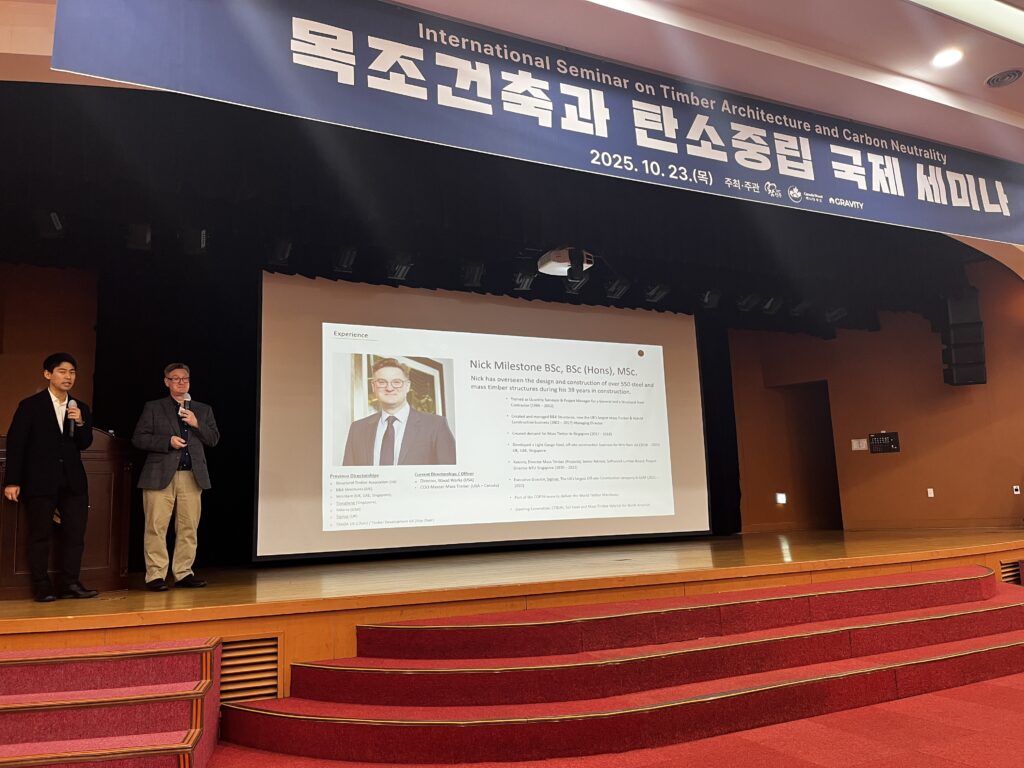
This interest aligns with recent shifts in Korea’s regulatory and policy environment that are improving conditions for mass timber construction. Since 2020, Korea has removed previous height and floor-area limits on wood buildings, enabling larger-scale timber applications. In addition, residential regulations have evolved to reduce long-standing barriers to wood-based multi-family housing, including changes related to concrete slab requirements.
Fire-safety compliance pathways for engineered wood are also becoming more practical, as standardized testing and acceptance routes reduce the need for project-specific approvals. Together, these changes are helping move mass timber from pilot projects toward broader market adoption.
Government and municipal initiatives are further supporting this transition. Public-sector programs and city-led policies—such as green building initiatives and proposed legislation to promote wooden architecture—are encouraging greater use of wood in public and low-carbon construction. At the same time, Korea’s growing focus on embodied carbon, supported by life-cycle assessment under green building frameworks, is strengthening demand for low-carbon structural solutions such as mass timber.
During the seminar and follow-up discussions, Mercer and Korean stakeholders explored potential project partnerships and technical collaboration tailored to local regulatory and construction environments. Canada Wood Korea will play a key facilitation role by connecting Mercer with Korean project teams and supporting the transition from dialogue to real project opportunities.