
Urban Regeneration Opens New Pathways for Modern Wood Construction in China

As China’s cities shift from rapid expansion to quality-focused urban renewal, modern wood construction is finding new relevance in places where people live, move, gather and experience the city every day.
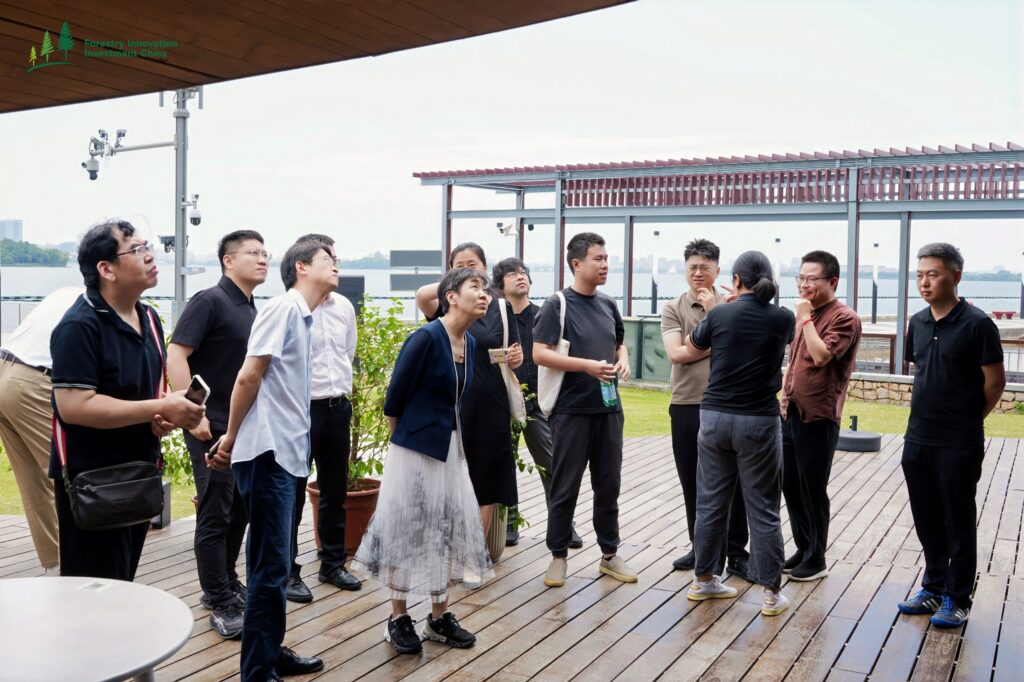
This was the central theme of a recent salon hosted by FII China in Suzhou, which brought together architects, developers, construction professionals and industry representatives to explore how wood construction can support urban regeneration and Complete Community development. Rather than focusing only on large-scale buildings, the discussion looked at a broader and increasingly important opportunity: community-scale public infrastructure, waterfront spaces, transit nodes, commercial public areas and neighbourhood renewal projects.
These projects are often smaller than conventional buildings, but they are numerous, visible and closely tied to the daily experience of urban life. They also align well with the strengths of modern wood construction: low embodied carbon, prefabricated installation, reduced site disruption, strong architectural expression and a warmer public environment.
The salon combined technical exchange with site visits to several built projects in Suzhou and Kunshan. These included waterfront pavilions, commercial public-space canopies and metro station facilities, showing how wood can be integrated into urban public infrastructure and placemaking. Together, the projects helped demonstrate that modern wood construction is not limited to residential or institutional buildings. It can also play a practical role in shaping more livable, human-scaled and low-carbon urban environments.

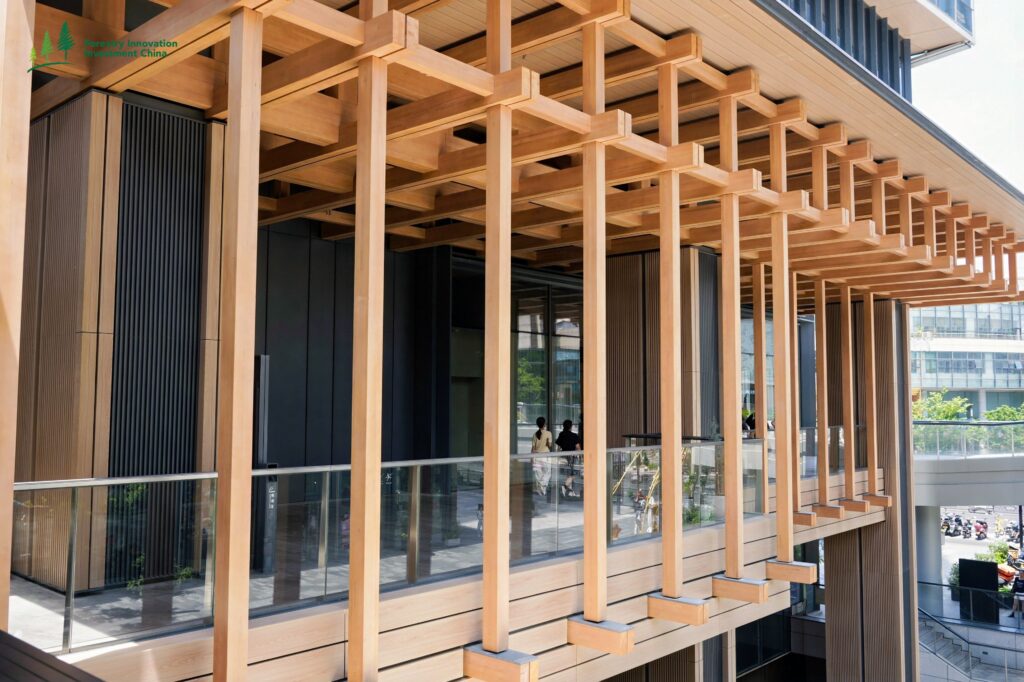
One highlight of the visit was a project supported by Canada Wood using Canadian yellow cedar glulam (see below images). The project is part of Canada Wood’s broader initiative to introduce and promote new Canadian species in China’s fast-growing glulam market. By demonstrating yellow cedar in a real built application, the project provides a tangible example of how Canadian wood products can support China’s demand for high-quality engineered wood materials while expanding species awareness among designers, developers and manufacturers.


The timing of the salon also reflected broader momentum in China’s policy and industry environment.
At the 2026 International Conference on Green and Building, wood construction received notable visibility in discussions around green building, low-carbon development and urban regeneration. Leading voices in China’s architectural community highlighted the role of wood and hybrid wood systems in reducing carbon impacts while supporting industrialized construction and design innovation. This signals an important shift: wood is increasingly being discussed not only as a niche material, but as part of a broader toolkit for sustainable urban development.
In parallel, the leadership transition of the Bamboo and Wood Structure Committee under the China Society for Urban Studies further reinforced the institutional attention now being given to modern bamboo and wood construction. The committee’s new five-year priorities — standards development, industry research, knowledge-sharing platforms and demonstration projects — point to a more structured pathway for advancing wood construction in China.
For Canada Wood and FII, these developments are encouraging. The conversation around wood construction in China is gradually moving from technical advocacy toward practical implementation. Policy signals, industry engagement and built demonstration projects are beginning to align around a shared direction: using wood to support lower-carbon, more adaptable and more people-centered forms of urban development.
Urban regeneration may become one of the most accessible near-term pathways for broader adoption of modern wood construction in China. Compared with large building projects, community-scale interventions often face fewer technical and regulatory barriers while giving owners, designers and local governments visible sustainability and design benefits.
As China continues to advance green building and urban renewal agendas, modern wood construction has a growing opportunity to contribute — not only as a structural solution, but as a way to create warmer, more sustainable and more human urban spaces.