

Reframing wood innovation in rural China: The Jiuceng Art Gallery

In March 2026, FII China hosted the “Envisioning Wood Construction: New Spaces and Practices” Forum in Beijing, building on the 2025 “Wood Construction Night” event. Among the invited speakers were the designers of the Jiuceng Art Gallery, a rural wood project in Shanlong village, Lishui, Zhejiang province that has drawn increasing attention in professional and international contexts.
This recognition was underscored in September 2025, when the project received an Honor Award at the Canadian Wood Council’s Wood Design & Building Awards. More than an individual achievement, the Jiuceng Art Gallery brings together traditional wood craftsmanship, contemporary design, and engineered timber systems-offering a clear example of how wood construction can evolve within a rural Chinese context.


Historic Context and Architectural Opportunity
Shanlong Village is a place where history and modernity coexist in a delicate balance. Nestled in the mountainous landscape of Lishui County, the village is home to wood-framed and rammed-earth houses that stand as enduring evidence of generations of craftsmanship and vernacular construction intelligence.
Unlike many rapidly urbanizing regions, Shanlong experienced a different trajectory. As economic activity shifted toward urban centres and younger generations migrated to cities, much of its built heritage was preserved rather than replaced. While this resulted in economic stagnation, it also unintentionally protected an invaluable architectural and cultural resource base.


Over time, this preservation has become a strategic advantage. It has allowed the village to maintain authenticity while creating conditions for cultural and design-led revitalization. In 2016, Shanlong was designated one of China’s Traditional Villages, which helped catalyze a wave of cultural and architectural initiatives.
Within this context, the Jiuceng Art Gallery emerged not simply as a building project, but as a catalytic intervention-demonstrating how contemporary architecture can be carefully embedded within a historically rich rural fabric in a way that respects tradition while enabling new spatial, social, and economic functions.
Wood Design: Bridging Craft and Engineering
The design of the Jiuceng Art Gallery reflects a deliberate integration of local craftsmanship heritage and contemporary engineered wood thinking. Built on the site of four abandoned homes, the project does not erase the original spatial logic of the village; instead, it reinterprets and reactivates it.
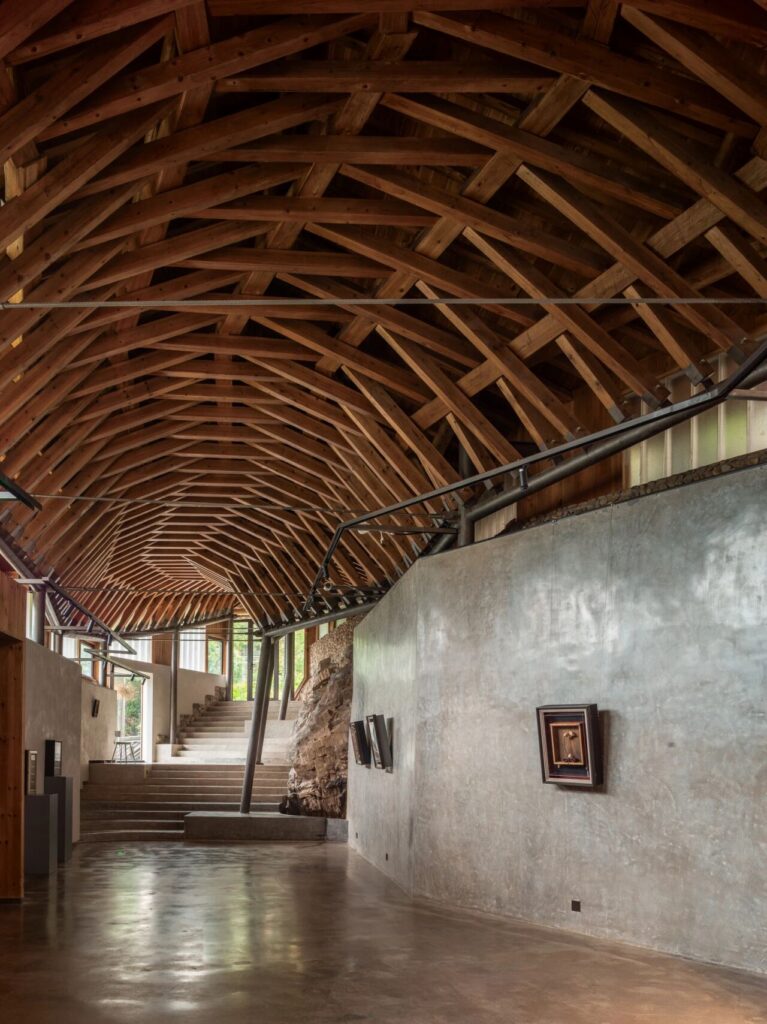
One of its most distinctive architectural features is the woven wood arch roof. This structural form is rooted in traditional construction knowledge and also echoes historical Chinese visual culture, including references found in classical depictions such as the Song Dynasty painting Along the River During Qingming Festival. The roof structure was constructed by local carpenters working alongside a master artisan, reinforcing the continuity of craft knowledge.
Technically, the structure achieves a large column-free interior space while demonstrating the adaptability of wood as a structural system. Through the enlargement of wood sections, improved joint detailing, and selective reinforcement strategies, the project successfully meets modern safety and performance requirements without losing the essence of traditional expression.
The project reflects principles aligned with modern engineered wood practice, including system-based thinking, performance-oriented design, and the translation of traditional wood knowledge into scalable structural solutions. In this sense, Jiuceng functions both as a cultural building and as an experimental intersection where heritage construction logic meets contemporary engineered wood methodology, allowing traditional techniques to be tested and reinterpreted within a modern framework.
More broadly, it illustrates that wood innovation is not limited to large-scale commercial or institutional buildings. It can also emerge from rural, culturally embedded contexts, where craftsmanship and engineering intersect to generate new architectural possibilities.

Cultural Revitalization and Community Impact
Beyond its architectural value, the Jiuceng Art Gallery has generated tangible social and economic impacts within Shanlong Village. It has become a focal point for cultural life, attracting artists, students, architects, and visitors, and contributing to the village’s transformation into an active creative and cultural destination.
This transformation is particularly important from a rural development perspective. Rather than displacing local identity, the project strengthens it. It creates a platform where cultural heritage becomes a living resource rather than a static memory.
Economically, the project has stimulated tourism and supported local income diversification. It has also contributed to the emergence of new culture-driven rural industries, demonstrating how architecture-led interventions can generate long-term community value that extends well beyond the physical building itself. It illustrates how wood construction can participate in broader development agendas, including rural revitalization, cultural preservation, and sustainable tourism. In this context, the built environment becomes a point of intersection between material innovation and evolving construction practices.
In this way, the Jiuceng Art Gallery positions itself not as a standalone statement, but as part of an ongoing exploration of how wood construction can respond to specific cultural and rural conditions.