

A BC Demonstration Project Seeding Broader Adoption of Wood in Guangdong

The broader adoption of wood construction in Guangdong can be traced back to a foundational moment in 2007, marked by the completion of a BC-supported wood structure in Zhujiang Park, Guangzhou. Developed through cooperation between Guangdong Province and British Columbia, and implemented by Canada Wood and the Guangzhou Municipal Bureau of City Engineering and Gardening, the project was explicitly conceived as a technical demonstration. Canadian-sourced wood products were treated with advanced anti-corrosion technologies to address long-standing concerns about durability under South China’s hot and humid conditions.


What distinguishes this project is not its architectural scale, but its temporal performance. Nearly two decades on, the structure—now operating as the “Bay Area Bookstore”—remains in continuous public use and has become one of Zhujiang Park’s most popular destinations, frequently attracting large crowds as a well-known public gathering and photo-taking spot. Its sustained functionality and high level of public engagement have provided local stakeholders with empirical reassurance that wood construction can withstand local environmental conditions without extraordinary maintenance regimes. In practical terms, it reduced perceived risk and shifted subsequent discussions from feasibility to application.
As confidence in baseline performance increased, attention turned to structural capacity. The Shenzhen Guangming International Equestrian Centre represents a critical inflection point in this regard. Designed as a large-scale international sports facility, the project imposed requirements—long spans, significant cantilevers, and high load demands—that traditionally favor steel or reinforced concrete solutions.

The main competition arena is supported by a mass timber roof structure composed of double-spliced glulam beams manufactured from Canadian Douglas fir. The system achieves a primary span of approximately 66 meters with cantilever extensions of 20 meters on each side. Individual structural elements reach up to 96 meters in length and weights of up to 37 tonnes.
In structural terms, the Guangming Equestrian Centre demonstrates that Douglas fir–based mass timber systems can reliably support mega-span applications under demanding load and performance requirements, extending the practical range of wood construction in China without overwhelming the broader architectural narrative.
Building on this demonstration of scale, other projects across the region illustrate how wood construction can integrate into more conventional development models while engaging with local architectural traditions, regardless of their exact construction timelines. The vivo Global Headquarters Reception Center in Dongguan illustrates this transition particularly clearly.
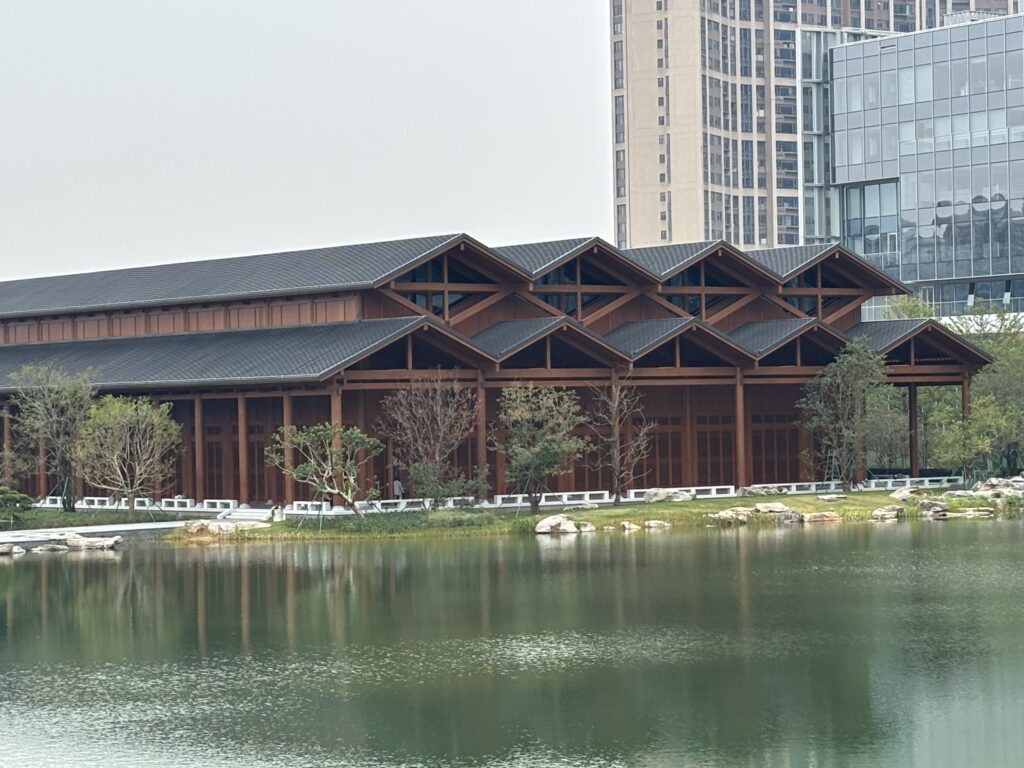

Developed within a corporate campus context, the project consciously draws on principles found in traditional Chinese wood architecture—such as modular logic, layered roof forms, and exposed structural order—while executing them through contemporary engineered wood systems. Glulam was employed to resolve large roof spans and articulate spatial layering, while CLT panels were incorporated into roof assemblies, allowing structure and interior requirements to be addressed simultaneously.
The extensive use of prefabricated mass timber components ensured predictable delivery, cost control, and construction efficiency, aligning wood construction with modern corporate development expectations. At the same time, the project demonstrates how modern wood construction can reinterpret traditional timber logic within a contemporary technological and programmatic framework, rather than positioning wood as a purely novel or imported solution.
In the realm of public architecture, the Kengzi Cultural and Technology Center in eastern Shenzhen reflects a different dimension of maturity. Covering more than 72,000 square meters, the project consolidates cultural, scientific, and community-oriented functions—including exhibition halls, a science and technology museum, reading spaces, and public service facilities—into a single civic complex. Within this context, wood construction plays a central organizational role, contributing to structural clarity, spatial rhythm, and environmental performance.


Rather than functioning as an isolated feature, the mass timber system is integrated with the building’s overall architectural logic, supporting large interior volumes while reinforcing a sense of openness and civic accessibility. As a landmark project intended to anchor cultural and technological development in eastern Shenzhen and the wider eastern Guangdong region, Kengzi demonstrates how engineered wood can operate credibly within large-scale public buildings, balancing structural demands with architectural expression.
The CanNano Exhibition Center, part of the GBA National Institute for Nanotechnology Innovation, extends Guangdong’s wood construction narrative into the realm of advanced geometry and digitally coordinated construction. Conceived as a spherical exhibition volume, the project represents China’s first realization of a mass timber grid-shell structure of this form.

The exterior shell is composed of a three-dimensional glulam lattice inspired by organic growth patterns and traditional mortise-and-tenon logic, reinterpreted through parametric design. This mass timber shell works in coordination with an internal steel structural core, allowing the building to achieve column-free interior spaces while maintaining geometric precision. The project relied on an integrated digital workflow linking computational design, precision fabrication, and controlled on-site assembly, demonstrating how digital processes can expand the formal and structural repertoire of wood construction without compromising constructability.
Taken together, these projects reflect a progressive resolution of technical and institutional barriers. Durability concerns have been addressed through long-term performance; structural limits have been tested and extended; construction efficiency has been demonstrated in commercial settings; and architectural legitimacy has been established across public and research-oriented buildings.
This accumulated experience has begun to shape a regional ecosystem. Nearly twenty years after the first demonstration project in Zhujiang Park, what began as a tentative experiment has taken root and gradually expanded. The early application of wood construction sowed a practical seed, tested by climate, public use, and time. Its broader adoption, however, has depended not on the project alone, but on a supportive environment—policies, technical capacity, market readiness, and sustained engagement—which together have enabled more projects to emerge across Guangdong.