

Advancing Fire Safety Dialogue for Mass Timber in China: Dr. Steven Craft’s Technical Exchange Visit

In early March 2026, Canadian fire safety expert Dr. Steven Craft completed a week-long technical exchange visit to China, meeting with leading research institutes, fire laboratories, and universities in Beijing, Tianjin, and Shanghai.
For Canadian stakeholders, the visit highlighted an important reality in the China market: interest in mass timber and low-carbon construction continues to grow, but fire safety remains one of the key barriers to broader adoption. While Chinese policymakers, researchers, and industry professionals are increasingly engaged in timber construction, current fire code provisions for wood buildings remain conservative and do not yet fully reflect the latest international research or practical experience. This creates uncertainty in design, approvals, and project implementation.
Against that backdrop, the visit provided a timely opportunity to position Canadian expertise in fire safety engineering as part of the solution. Through workshops, technical discussions, and academic outreach, Dr. Craft shared Canada’s experience in supporting the safe and code-compliant use of mass timber, while also strengthening relationships with the Chinese organizations that influence research, standards, and market acceptance.
The program focused on Canada’s integrated approach to fire safety in wood buildings, including:
- the evolution of fire provisions in Canada’s building codes
- large-scale fire research and structural fire performance testing
- fire safety design methodologies for timber buildings
- performance-based pathways for projects that go beyond prescriptive code limits
For Canada’s forest sector, this type of engagement is strategically important. Technical acceptance is a prerequisite for market growth in mass timber. By sharing Canadian research, regulatory experience, and project examples, Canada Wood is helping build the confidence needed for future timber code development and broader use of advanced wood systems in China.
Technical Exchange in Beijing
The visit began in Beijing on March 2, where Dr. Craft delivered technical workshops at the Fire Research Department of the China Academy of Building Research (CABR) and the National Center of Technology Innovation for Green Carbon (NCTIGC).
CABR is one of China’s leading institutions in building science and engineering, while NCTIGC is a national innovation platform focused on green and low-carbon construction technologies. The sessions brought together researchers, engineers, and code specialists to discuss regulatory approaches to timber construction and the role of fire safety research in enabling new building systems.
A central topic was Canada’s objective-based building code framework, introduced in 2005. Under this system, projects may follow prescriptive Acceptable Solutions set out in the code, or pursue Alternative Solutions supported by performance-based engineering analysis that demonstrate an equivalent or higher level of safety. This framework has been instrumental in allowing Canada to expand the scale and height of wood buildings while maintaining rigorous fire safety standards.
For Chinese participants, the discussion offered a practical example of how code systems can evolve alongside research and innovation. For Canada, it reinforced the value of sharing technical and regulatory experience in markets where code development will shape future demand for mass timber systems.

Technical Exchange in Tianjin
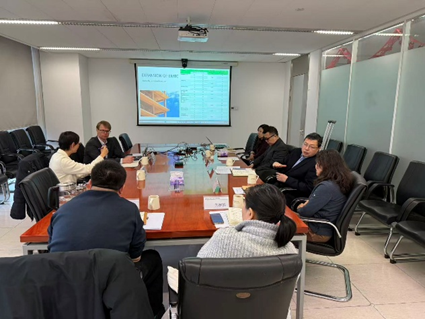
On March 3, Dr. Craft travelled to Tianjin to visit the Tianjin Fire Research Institute (TFRI), one of China’s leading fire research institutions and a key contributor to the development of national fire safety standards.
Discussions in Tianjin focused on experimental research related to timber fire performance and structural fire resistance. Researchers exchanged views on compartment fire behaviour, the performance of combustible structural materials under fire exposure, and emerging research priorities related to mass timber construction.
Dr. Craft also toured TFRI’s large-scale fire testing laboratories, which support advanced research on building materials and fire safety systems. A meeting was also held with representatives from Tianjin Taida Fire Protection Technology Co. Ltd. to learn more about recent fire testing programs and fire engineering design work underway in China.
For Canadian stakeholders, the Tianjin visit underscored the importance of engaging directly with the institutions that generate the technical evidence behind future code and market acceptance. Establishing these research-level connections helps ensure Canadian wood systems and design approaches are part of the conversation as China evaluates pathways for timber construction.


Academic Outreach in Shanghai
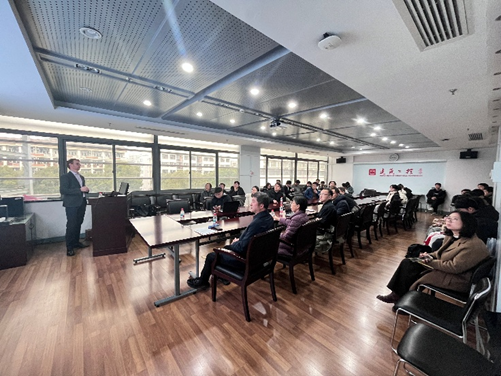
The final stop was Shanghai, where Dr. Craft delivered a lecture at Tongji University titled Canada’s Approach to Fire Safety in Wood Construction. Hosted by the Faculty of Civil Engineering, the lecture was attended in person and online through the Canada Wood training platform by approximately 100 faculty members, researchers, graduate students, and industry professionals.
In his presentation, Dr. Craft reviewed the evolution of fire provisions for timber buildings in Canada over the past 15 years and explained how research has supported progressive code updates. He highlighted how large-scale fire testing in Canada has improved understanding of key issues in mass timber buildings, including charring behaviour, encapsulation strategies, and structural resilience after fire exposure.
To demonstrate the practical application of performance-based design, Dr. Craft also presented Limberlost Place, the 10-storey mass timber academic building at George Brown College in Toronto. The project illustrated how advanced fire engineering can support innovative timber architecture while meeting stringent safety objectives.
While in Shanghai, Dr. Craft also visited the Shanghai Research Institute of Building Science (SRIBS), a leading applied research institute focused on building technology, materials performance, and structural engineering. Researchers there shared ongoing work on the fire performance of wood and bamboo materials and structural systems, and the visit included a tour of the institute’s structural testing laboratory.
The Shanghai program helped broaden the reach of the visit beyond specialist research circles to include the next generation of engineers, academics, and technical leaders who will influence the future direction of timber construction in China.


Why This Matters for Canada
China is still at an early stage in the development of modern mass timber policy and practice, but interest is clearly growing as the country looks for lower-carbon construction solutions. Fire safety remains one of the most important technical issues shaping that transition.
This visit demonstrated how Canadian expertise can support informed dialogue in this area. By bringing forward Canada’s code experience, fire research, and project examples, Canada Wood is helping create the technical understanding and institutional relationships that can support long-term market development.
For the Canadian forest sector, these exchanges are about more than knowledge sharing. They are part of the groundwork needed to improve confidence in timber construction, influence future technical pathways, and support expanded opportunities for Canadian wood products and building systems in one of the world’s most important construction markets.

This project was made possible through funding support from Natural Resources Canada.